Unusual Automation in M&A: Three Practical Ways to Improve Deal Work
This blog is in the Top 25 M&A blogs worldwide according to Feedspot.
The interesting question about AI in M&A is not whether it can write a summary. It is whether it can help us execute a defined task more systematically, uncover information we would otherwise miss, or ask better questions before committing to a transaction.
That was the focus of my presentation at ReThink! M&A in September 2026. My subjective selection brought together three different approaches: AI Skills built on an M&A reference model, trade intelligence from ABRAMS world trade wiki, and AI-defensibility assessments with Liz from Sema. Their common denominator is practical usefulness, not novelty for its own sake.
Start with the task, not the tool
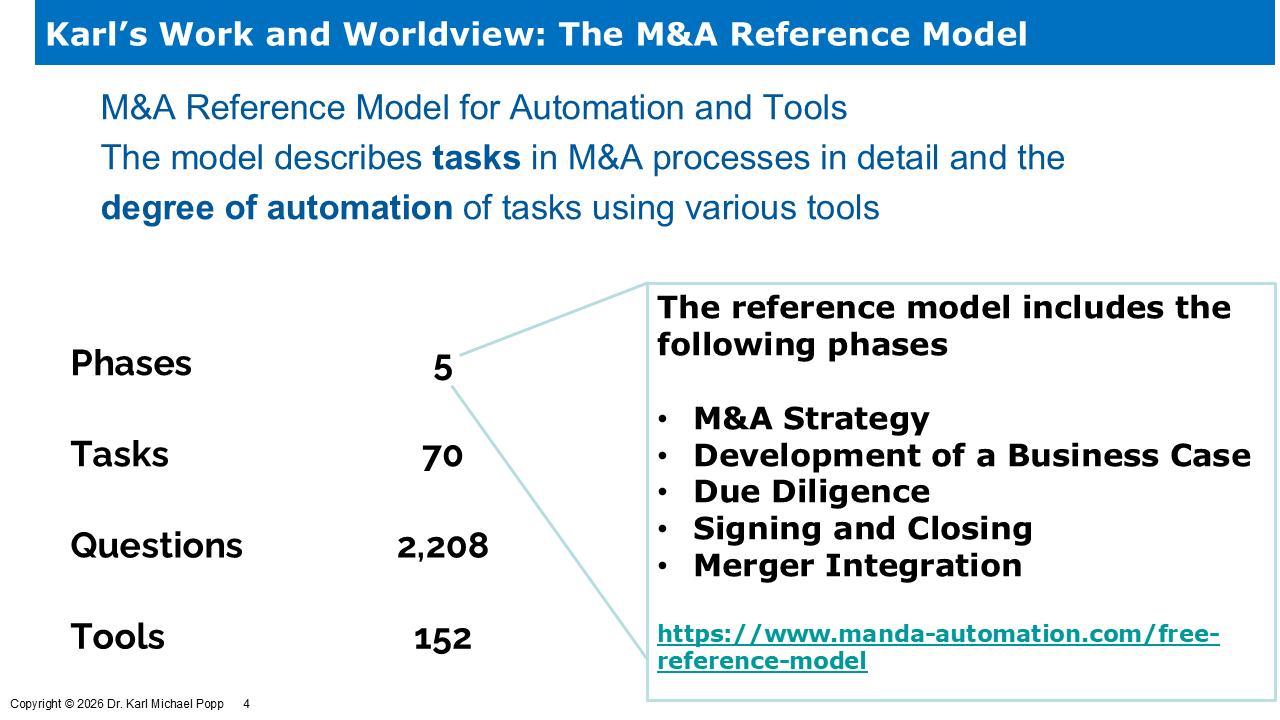
My starting point is the M&A reference model. The version presented at the conference comprises five phases, 70 tasks, 2,208 questions and 152 tools, connecting the work of a transaction with the tools and degree of automation available to support it.
The five phases cover M&A strategy, development of a business case, due diligence, signing and closing, and merger integration. Within each phase, the model describes tasks, actions, relevant information and questions to ask.
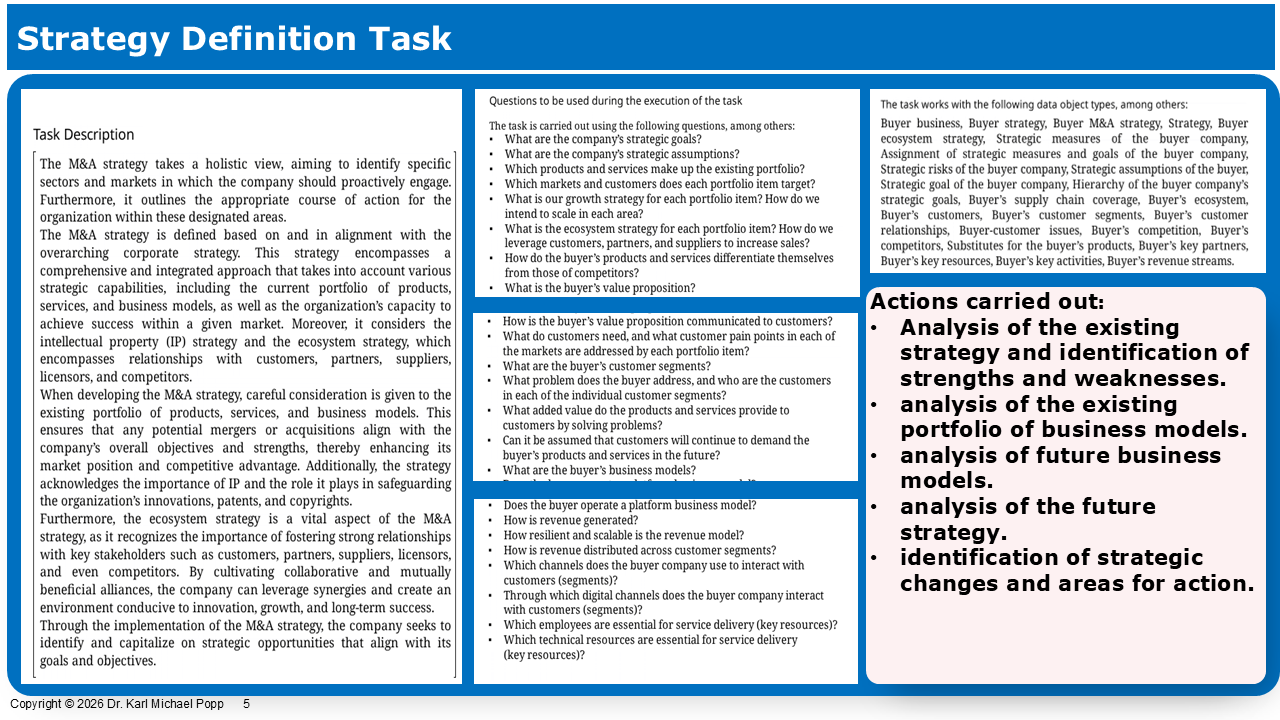
Consider strategy definition. Before searching for targets, we should examine the buyer’s existing strategy, portfolio of business models, future business models and intended strategic changes. Product positioning, intellectual property, customer relationships and the wider ecosystem belong in that analysis.
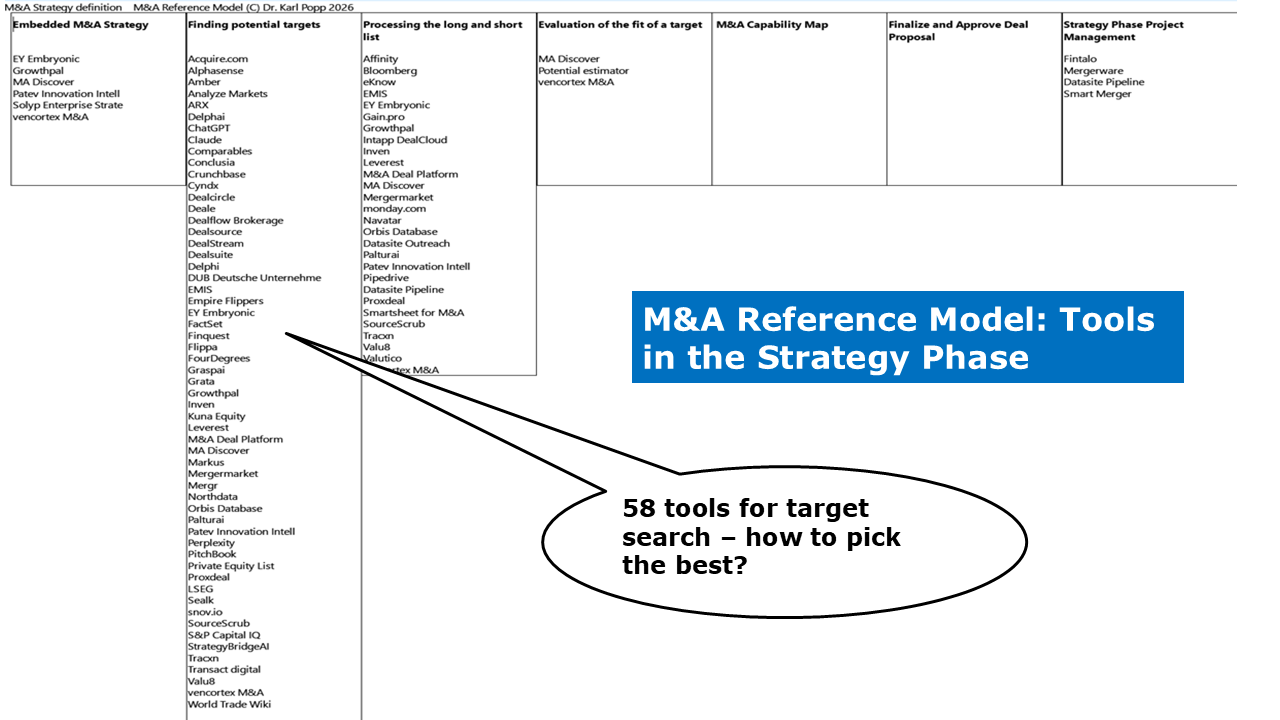
This structure also helps with tool selection. My presentation lists 58 tools for target search alone. The useful question is therefore not “Which tool is best?” but “Which tool best supports this task, with the information and access we actually have?”
Readers can explore the free, redacted M&A reference model (https://www.manda-automation.com/free-reference-model). It provides a starting point for discussing what to automate before deciding what to buy.
AI Skills: turn a method into a repeatable workflow
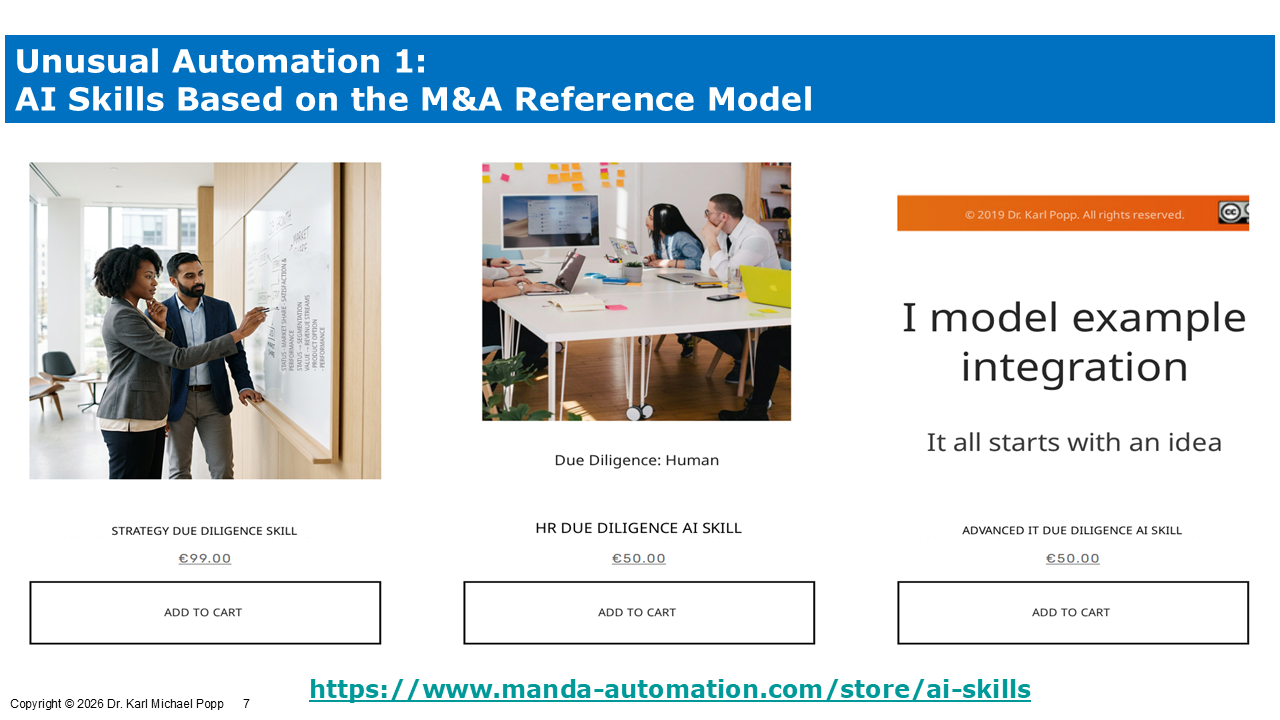
The first example brings the reference model directly into AI-assisted work. My M&A AI Skills (https://www.manda-automation.com/store/ai-skills) package structured instructions for workstreams such as strategy, HR and IT due diligence.
The distinction from a generic prompt is important. Asking an AI assistant to “perform IT due diligence” leaves scope, access restrictions, deliverables and escalation rules largely undefined. A skill can make those decisions explicit before analysis begins.
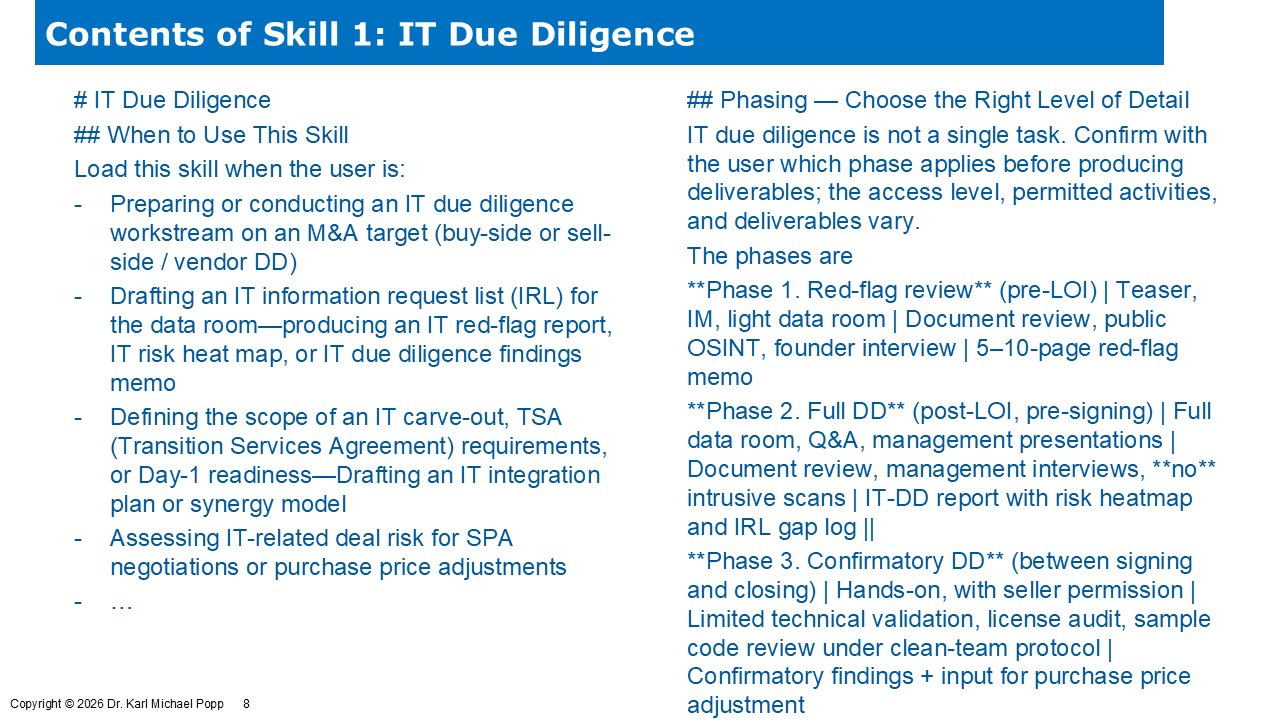
The IT due diligence example in the presentation starts by confirming the phase:
- Red-flag review: Before the letter of intent, work with limited materials and produce a focused memo highlighting issues requiring attention.
- Full due diligence: After the letter of intent and before signing, use the data room, Q&A and management interviews to develop findings and a risk heatmap, without intrusive scans under this workflow.
- Confirmatory due diligence: Between signing and closing, perform agreed technical validation with seller permission and appropriate clean-team safeguards.
These are the skill’s scoping rules, not a claim that every transaction follows an identical timetable. The point is to align the work with the deal’s permissions and information access.
The skill then guides the information request list, analysis of applications and infrastructure, security review, risk scoring, and assessment of integration costs and synergies. It also requires explicit handovers to other diligence teams: license exposure to financial diligence, contract and IP questions to legal diligence, key-person dependencies to HR, and service reliability to commercial diligence.
For example, a software license issue should not remain an isolated technical observation. It may affect costs, contractual rights and the integration plan. My aim is to make those connections harder to overlook, while leaving expert judgment and approval with the deal team.
ABRAMS world trade wiki: look beyond the data room
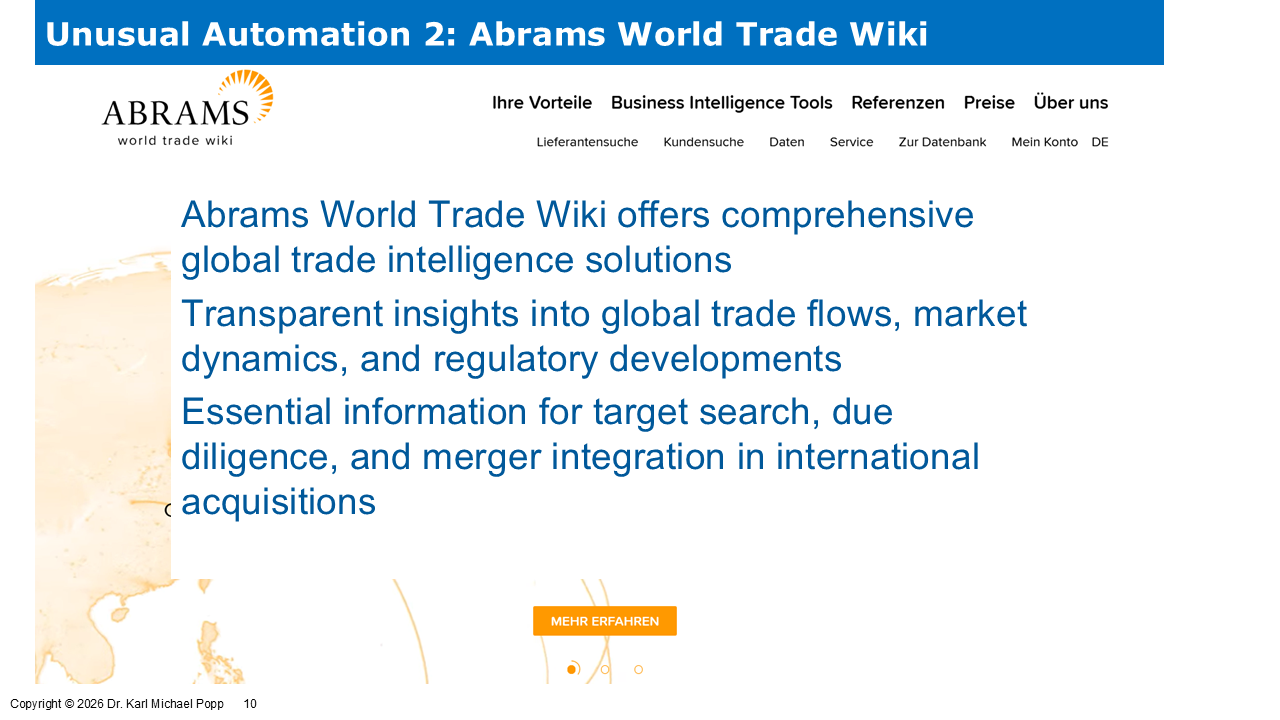
The second example uses a source of information that may not appear on a conventional M&A tool shortlist. ABRAMS world trade wiki (https://en.abrams.wiki/) combines trade information, including customs and UN Comtrade data, in a business intelligence platform.
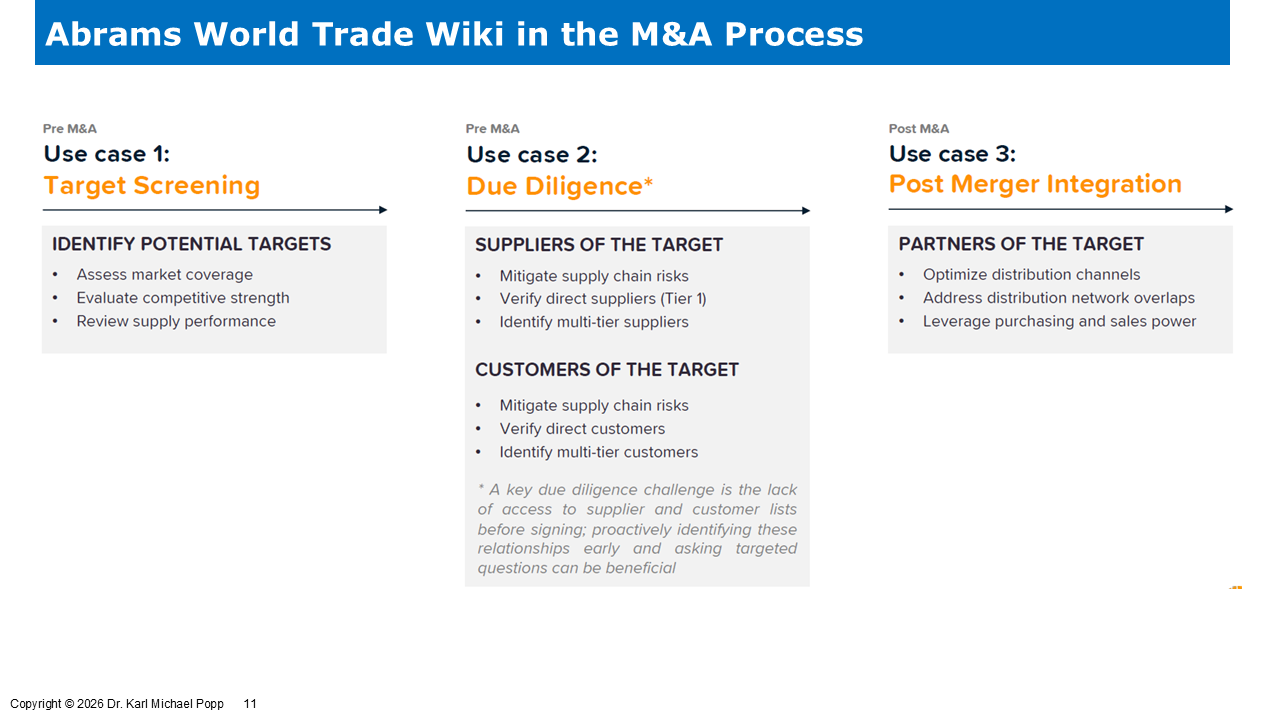
In the presentation, I map its potential use across three transaction activities:
- Target screening: Assess market coverage, competitive strength and supply performance.
- Due diligence: Investigate supplier and customer relationships, including dependencies beyond the first tier.
- Post-merger integration: Examine distribution overlaps and opportunities to coordinate purchasing and sales.
The practical attraction is early visibility. If detailed supplier or customer lists are not yet available, trade data can provide leads for targeted questions rather than forcing the team to wait for a fuller disclosure package.
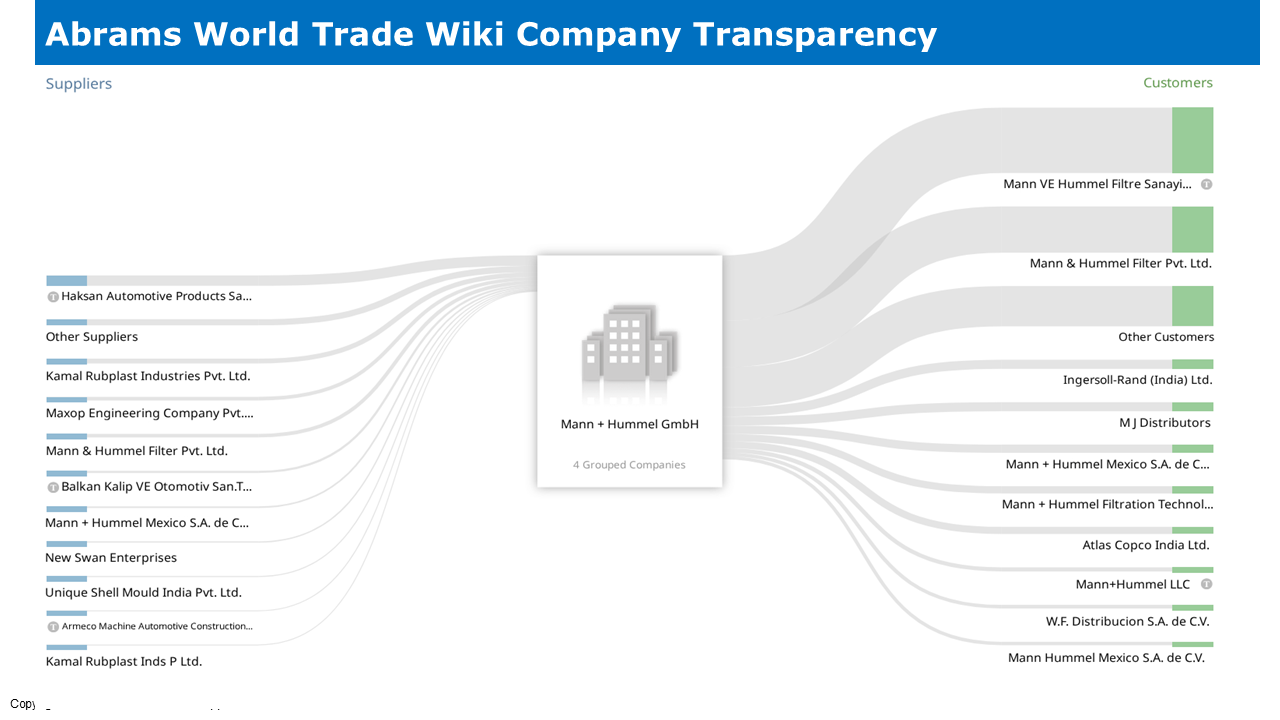
The presentation illustrates this with a supplier-and-customer network around Mann + Hummel GmbH. The visualization connects a company with its trading relationships, turning individual records into a picture of its business network. It is a demonstration of the analytical approach, not a statement that the company is an acquisition target.
For an industrial transaction, I would use such evidence to formulate hypotheses: Is a supplier relationship concentrated? Are apparent customers group entities or independent buyers? Where might the buyer’s and target’s distribution networks overlap?
Those hypotheses still require validation. I would not treat observed shipments as a complete customer list or as a substitute for revenue data. The value is in identifying what to investigate next.
Liz from Sema: assess AI defensibility before opening the data room
The third example addresses a strategic question: how vulnerable are a software company’s products and business model to AI disruption? In this presentation, my focus on Liz from Sema is specifically its AI-defensibility assessment (https://www.manda-automation.com/tools/2025/3/28/semasoftware-ai-defense).
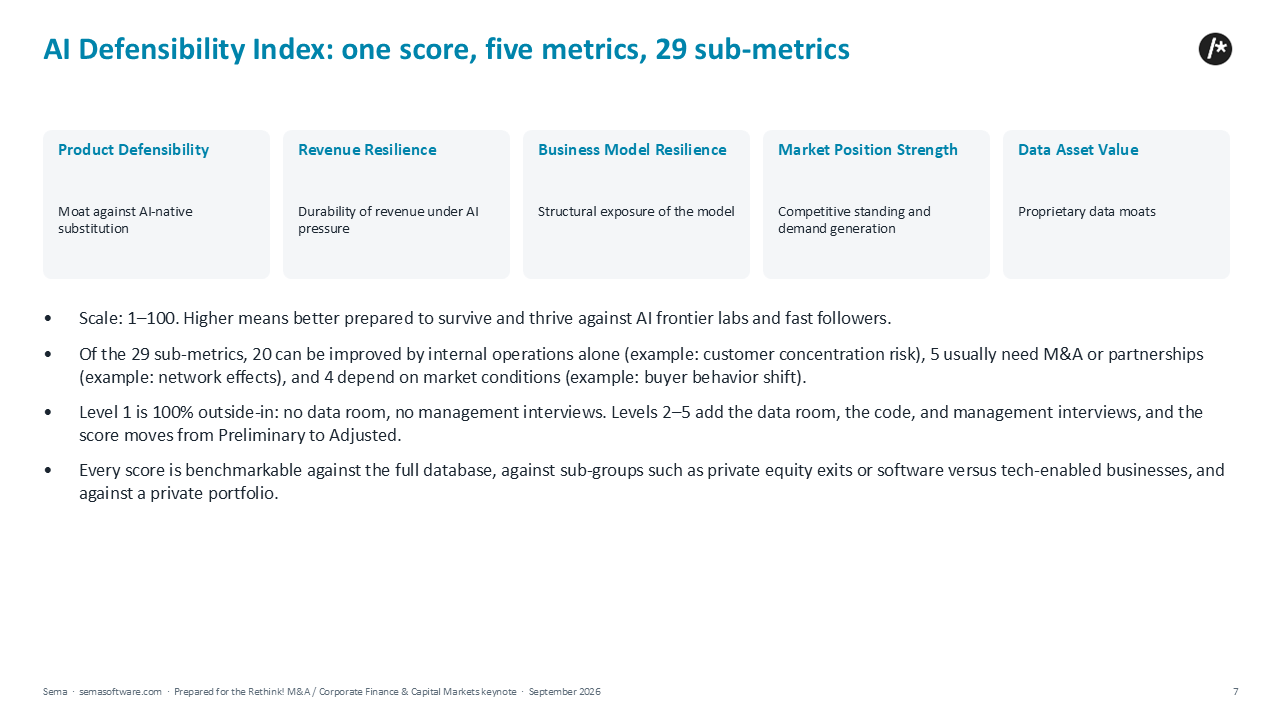
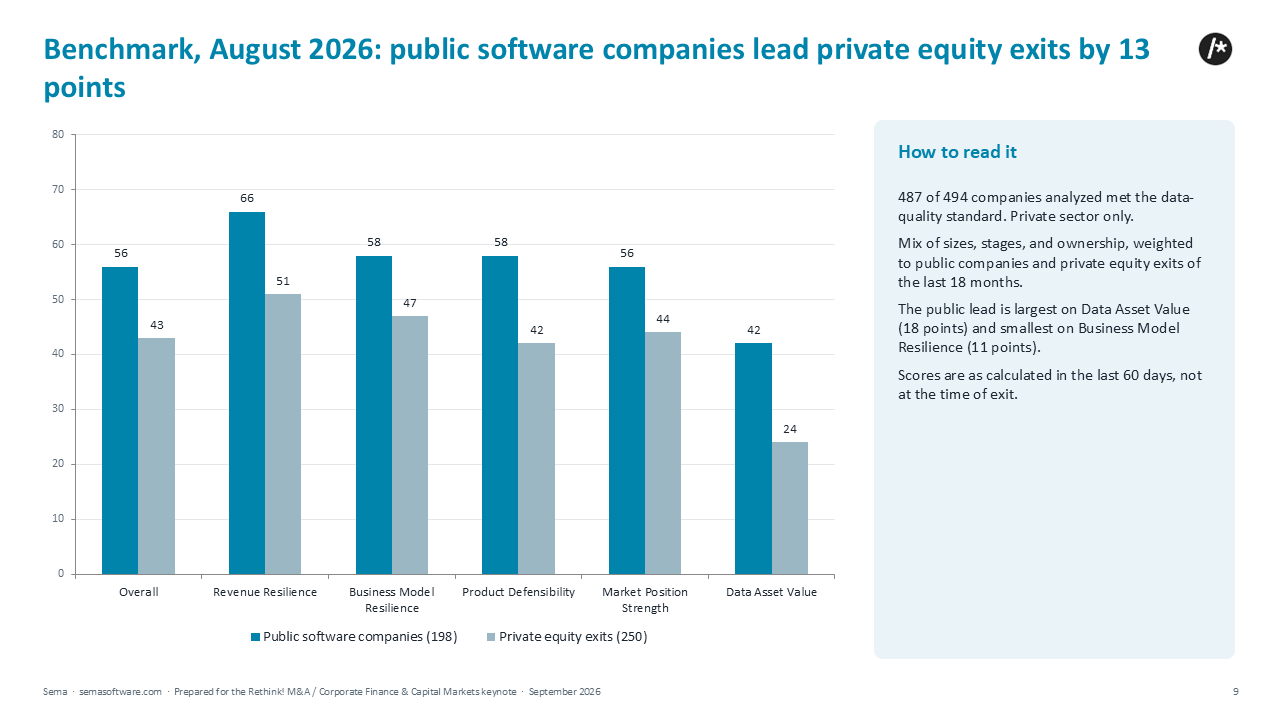
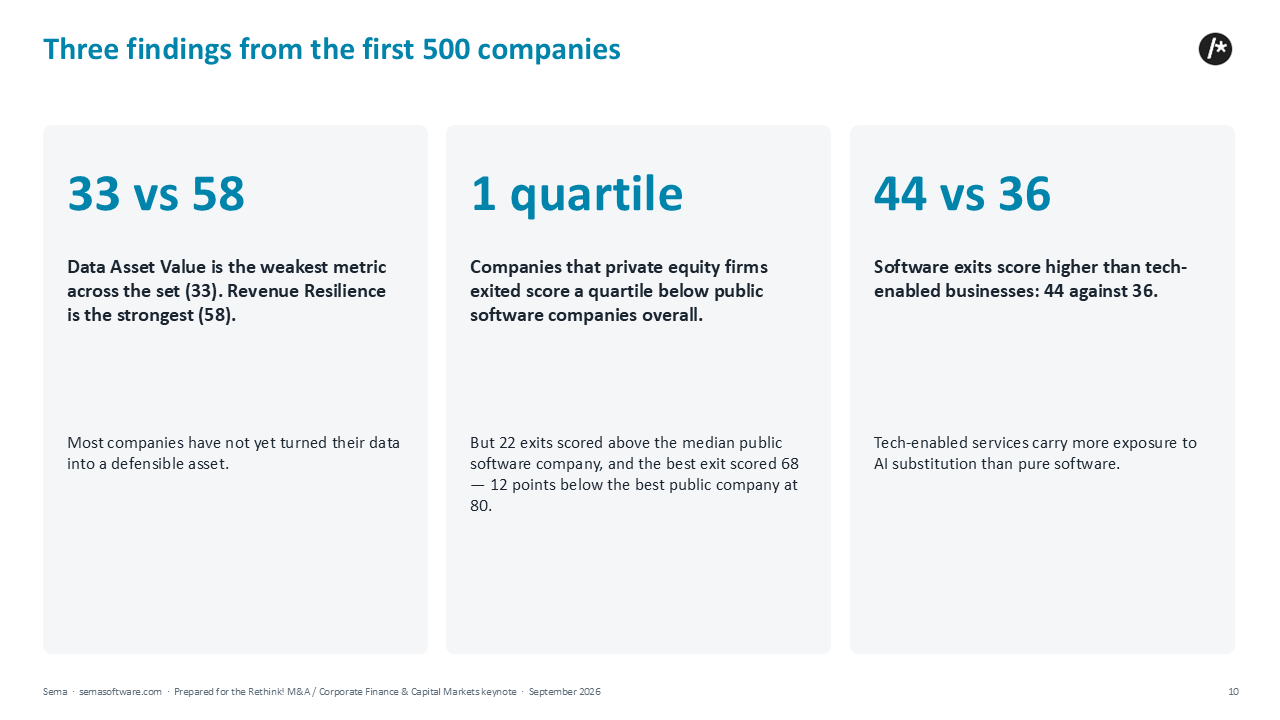
The analysis results in an index scored from 1 to 100, with five dimensions and 29 sub-metrics, benchmarked against approximately 600 companies. The dimensions examine:
- Product defensibility: Competitive advantage against AI-based substitution.
- Revenue resilience: Sustainability of revenue under AI pressure.
- Business model resilience: Structural vulnerability of the business model.
- Market position strength: Competitive position and demand generation.
- Data asset defensibility: Competitive advantages arising from proprietary data.
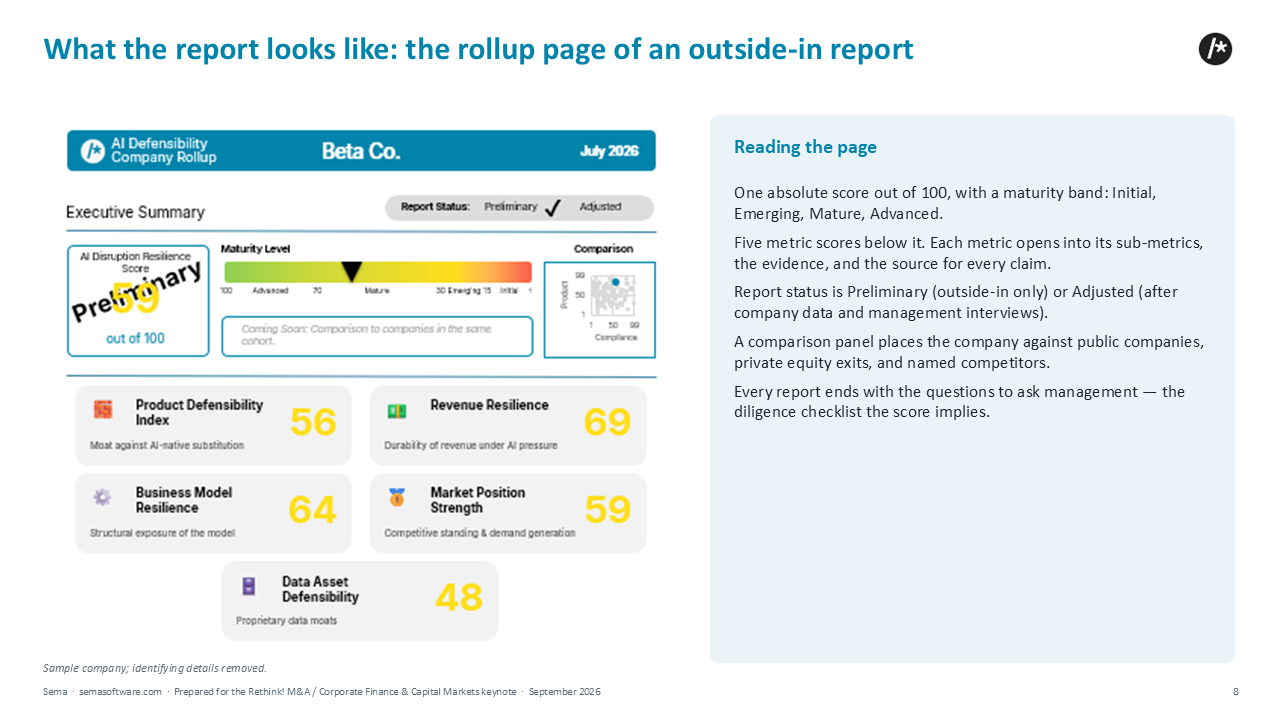
The entry point is an outside-in assessment requiring no confidential company data, management interviews or source code. Its status is explicitly preliminary. Subsequent stages add internal evidence and move the assessment toward an adjusted rating.
The anonymized “Beta Co.” example in the presentation shows why the breakdown matters. Its overall score is 59, but revenue resilience scores 69 while data asset defensibility scores 48. Rather than treating the headline number as a verdict, I would use that difference to ask where resilience comes from and which assumptions need testing.
The most useful output is not simply a score. The approach connects sub-metrics with evidence and sources, then derives a due diligence checklist.
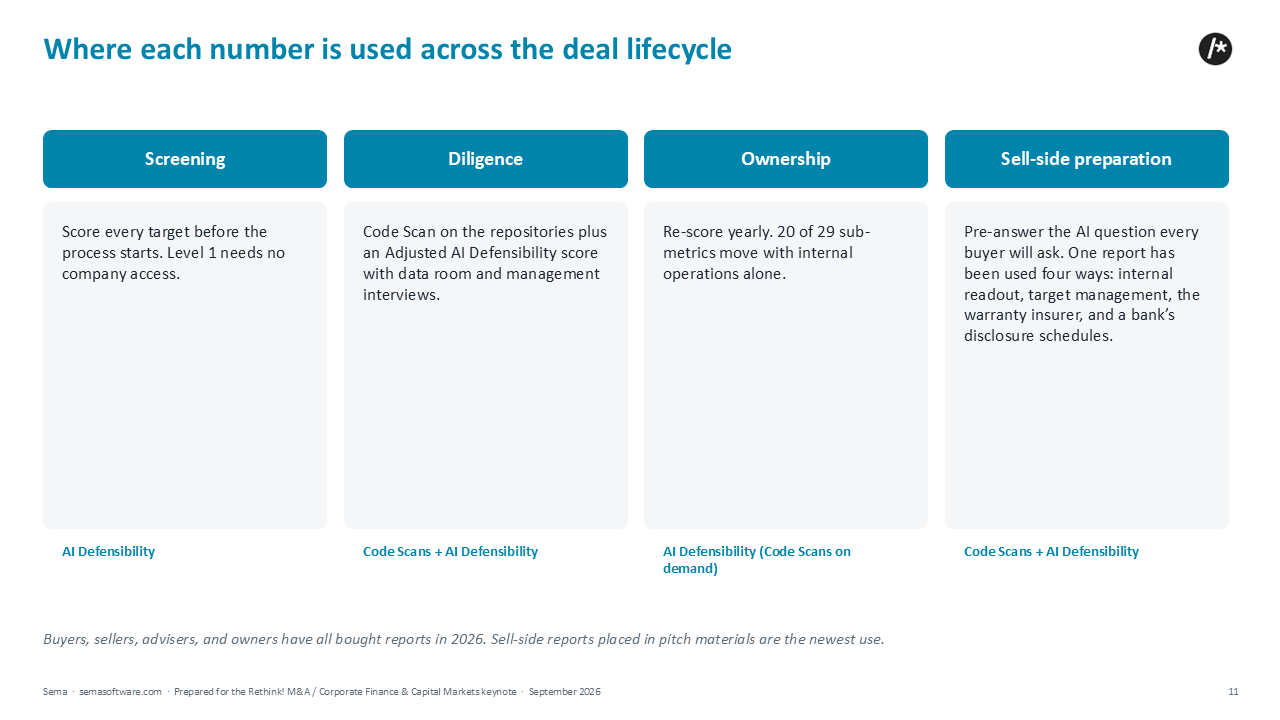
It also links assessment to action. In the framework presented, 20 sub-metrics can be improved through internal measures, five typically require M&A or partnerships, and four depend on market conditions. That distinction helps separate management’s actionable priorities from external uncertainties.
For buyers, this can structure early screening and subsequent diligence. For sellers and portfolio companies, it can inform preparation and value-creation planning. A preliminary outside-in rating should begin the investigation, not replace it.
Choose one task and test the difference
These examples tackle different problems: AI Skills structure execution, trade intelligence broadens the evidence base, and AI-defensibility assessments sharpen strategic questions. My recommendation is to test them against a specific task and judge the quality of the resulting work, not the fluency of the output.
Start with the M&A reference model (https://www.manda-automation.com/free-reference-model), explore the AI Skills (https://www.manda-automation.com/store/ai-skills), or investigate ABRAMS world trade wiki (https://www.manda-automation.com/tools/abrams).
If you would like to assess the AI defensibility of your company, a portfolio business or an acquisition target, contact me about Liz from Sema or click here: https://www.manda-automation.com/tools/2025/3/28/semasoftware-ai-defense.
As Sema’s partner for the DACH region, I can also discuss a DACH-specific benchmark. Bring one company and one concrete question, and let us explore what the assessment can add.
By Dr. Karl Michael Popp
Contact: karl_popp@hotmail.com
Dr. Karl Michael Popp is an M&A expert and author specializing in software company acquisitions.Contact: +49 6202 5829917 | www.drkarlpopp.com
Parts of this blog might be AI generated