Where AI Actually Lands in the M&A Strategy Phase
This blog is in the Top 25 M&A blogs worldwide according to Feedspot
A look at 38 M&A tools and where they apply ML today
When people talk about "AI in M&A," the conversation usually jumps straight to data rooms, contract review, or post-merger integration analytics. The strategy phase — the front end of a deal, before any NDA is signed — gets surprisingly little attention. Yet this is where the most consequential decisions are made: what to buy, why, and which targets even deserve a closer look.
To get a clearer picture, I mapped 38 M&A tools against the activities of the strategy phase in my M&A Reference Model and counted how many of them use machine learning for each activity. The result is the histogram below — and it tells a very specific story about where ML has earned its keep, and where it has not (yet).
The headline pattern: ML clusters around target sourcing
The single most striking observation is that ML usage is heavily concentrated in one sub-phase: Finding potential targets.
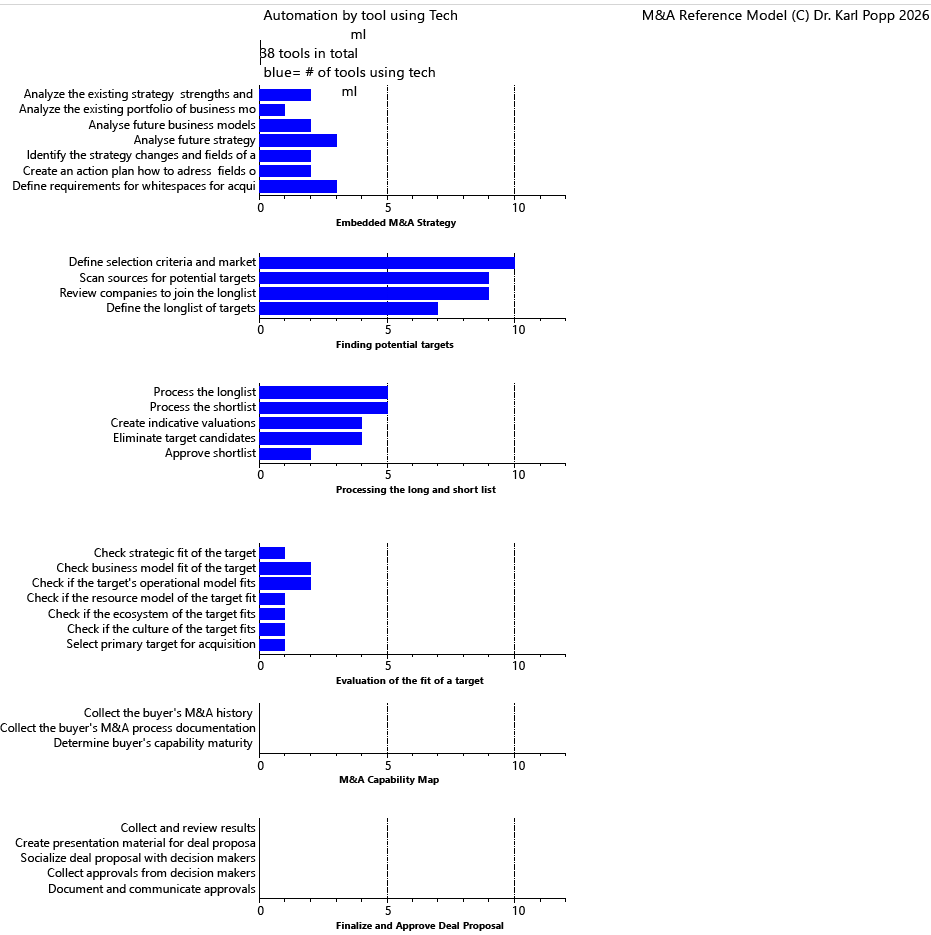
Across the four activities in that block, ML adoption is dramatically higher than anywhere else in the strategy phase:
Define selection criteria and market — ~10 tools
Scan sources for potential targets — ~9 tools
Review companies to join the longlist — ~9 tools
Define the longlist of targets — ~7 tools
This is exactly where you would expect ML to shine, and the market has clearly figured that out. Sourcing is a high-volume, pattern-matching problem: ingest millions of company records, score them against fuzzy criteria, surface look-alikes, cluster by business model, detect signals (hiring, funding, web traffic, patents, product launches). Every one of these is a textbook ML use case — embeddings, classifiers, ranking models, and increasingly LLM-driven enrichment.
In other words: when the problem looks like "search and rank at scale," ML vendors have shown up in force.
The middle ground: list processing and embedded strategy
Two blocks sit in the middle of the distribution.
Embedded M&A Strategy — the activities that connect corporate strategy to M&A — shows modest but consistent ML usage (2–3 tools per activity):
Define requirements for whitespaces for acquisitions
Create an action plan to address fields of acquisition
Identify strategy changes and fields of acquisition
Analyse future strategy / future business models
Analyze the existing portfolio and strategy strengths
These are inherently analytical activities — portfolio analysis, whitespace detection, scenario modeling. ML is showing up here, but cautiously. The work is more judgment-heavy and less amenable to "score 50,000 companies and return the top 100."
Processing the long and short list sits at 4–5 tools per activity:
Process the longlist / shortlist
Create indicative valuations
Eliminate target candidates
Approve shortlist
Indicative valuation is the most interesting line here. Comparable-company analysis, multiples, and transaction comps are exactly the kind of structured numerical problem where ML can add real lift — and the data shows several tools are doing it.
Where ML is conspicuously absent
This is, for me, the more interesting half of the chart. Several sub-phases show almost no ML adoption:
Evaluation of the fit of a target (1–2 tools per activity) — strategic fit, business model fit, operational fit, resource model fit, ecosystem fit, cultural fit, primary target selection.
M&A Capability Map (essentially zero) — buyer's M&A history, process documentation, capability maturity.
Finalize and Approve Deal Proposal (essentially zero) — presentation material, socializing with decision makers, collecting and documenting approvals.
Strategy Phase Project Management (essentially zero) — project goals, governance, work management, progress reporting, learnings.
Two patterns explain this.
First, "fit" is genuinely hard. Strategic, cultural, operational, and ecosystem fit are multidimensional, context-dependent, and rely on tacit knowledge of both buyer and target. There is no public training set for "does this target's culture fit ours." LLMs could help here — and I expect this column of the histogram to grow fastest over the next 12–24 months — but the current generation of dedicated M&A tools mostly hasn't built it yet.
Second, capability mapping, approval workflows, and project management are workflow problems, not pattern-recognition problems. They benefit from good software, not necessarily from ML. Expecting ML to dominate here is a category error.
What this means for M&A practitioners
A few takeaways for anyone building or buying M&A tooling for the strategy phase:
If a vendor pitches "AI-powered M&A," ask which activity. If the answer is sourcing/longlisting, the claim is credible — the whole market is there. If the answer is "fit evaluation" or "approval workflow," ask hard questions about what the model actually does.
The biggest unmet opportunity is fit evaluation. Strategic, business model, operational, and cultural fit are where deal value is created or destroyed — and where ML penetration is in the low single digits. LLMs with access to structured target data, internal strategy documents, and historical deal outcomes are a natural next step.
Indicative valuation deserves more ML attention than it gets. Four to five tools is a start, but valuation modeling — especially for software targets, where my own work is concentrated — is still mostly spreadsheet-driven. There is room for serious ML-assisted valuation tooling.
Don't expect ML in M&A project management. That's fine. Project management needs good workflow software, audit trails, and integration — not a neural network.
Methodology note
The sample is 38 M&A tools across the strategy phase of my M&A Reference Model. "Uses ML" is counted at the tool–activity level: if a tool applies machine learning to a given activity, it contributes one to that bar. The chart is a snapshot — vendor capabilities shift quickly, and I expect the "fit evaluation" and "embedded strategy" bars to grow meaningfully in the next refresh.
M&A Reference Model © Dr. Karl Popp, 2026.
Parts of this post might be AI generated